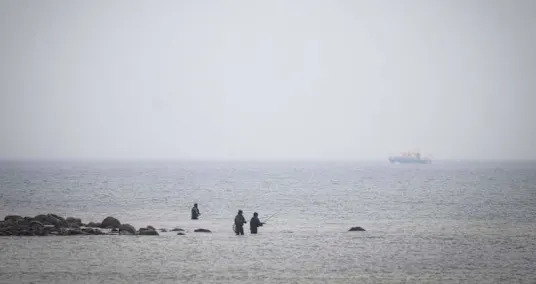
A humpback whale stranded for days off Germany's Baltic coast has gotten stuck on another sandbank, a Greenpeace spokeswoman said on Saturday.
The unlucky animal had garnered media attention for days, after it got stranded on a sandbank off Germany's Timmendorfer Strand resort, near the city of Lübeck, early on Monday.
Days of efforts to free the 12- to 15-metre whale proved unsuccessful until rescuers dug out a channel in the sand around the animal using a floating excavator on Thursday, allowing the whale to swim free the following night.
However, environmentalists and marine experts had feared that the animal could potentially get stuck again, as it was spotted heading back towards shallower water following its release.
Those fears became reality on Saturday, with the whale spotted stranded on a sandbank in the Bay of Wismar, some 40 kilometres to the east of Timmendorfer Strand, according to Greenpeace.
Large whales such as humpback whales are not native to the Baltic Sea. They may follow schools of fish in search of food and end up in the Baltic Sea.
According to experts, underwater noise could also play a role.

LATEST POSTS
- 1
 KJ Apa stars as Jimmy Stewart in new biopic: See his transformation
- 2Israel Police decry online defamation campaign against female officer in Jerusalem
- 3UN warns civil liberties under threat due to war in Middle East
- 4Fuel Price Spike Drives Surge in Used EV Sales in Europe
- 5Global measles cases drop 71% in 24 years as vaccination coverage improves, WHO says


- Foods with healthy-sounding buzzwords could be hiding added sugar in plain sight
- I’m a dad to an autistic child. Here’s how you can make the holidays easier for all of us.
- This cafe takes orders in sign language. It's cherished by the Deaf community
- Saturn shines with the waxing moon at sunset on Nov. 29
- The Main 20 Photography Instagram Records to Follow
- 8 Fundamental Stages: Novice's Manual for Secure Your Android with a VPN
- Dark matter obeys gravity after all — could that rule out a 5th fundamental force in the universe?
- NASA's moon mission has begun — here's what's ahead for the Artemis II astronauts
- Can a mammogram help identify heart disease?