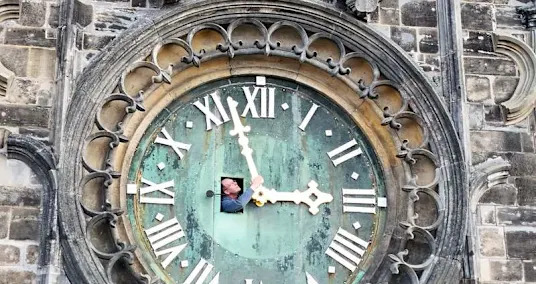
Clocks across the majority of European countries are set to go forward by one hour early on Sunday as the continent moves to daylight saving time, also known as summer time.
Clocks in most European nations including Germany advance by one hour at 2 am (0100 GMT) to 3 am, heralding longer evenings and brighter days.
This means that for the coming months parts of Europe will be on Central European Summer Time (CEST), before moving back to Central European Time (CET) in the autumn, when clocks go back again by an hour on October 25.
The aim of the change is to make better use of daylight in the shorter days of the winter in the northern hemisphere.
The signal for the automatic changeover of the clocks in Germany comes from the Federal Institute of Physics and Metrology (PTB) in the northern city of Braunschweig, also known as Brunswick in English.
The institute's experts ensure that radio-controlled clocks, station clocks and many industrial clocks are supplied with the signal via a long-wave transmitter called DCF77 in Mainflingen near Frankfurt.
LATEST POSTS
- 1
 Extravagance SUVs for Seniors: Solace, Innovation, and Security
 - 2Green Inflections: A Manual for Inside Plants
- 3Study shows no clear link between low-fat dairy and dementia risk
- 4Environmental groups urge Germany to cut oil and gas dependence
- 5Step by step instructions to Choose the Right Internet based Degree Program for Your Future




- Heavy rain, floods kill at least 45 people in Afghanistan, Pakistan
- ‘Nahariya get ready’: Banner displaying Hezbollah threat mounted in Tehran’s Palestine Square
- South Korea to End Bear Bile Farming and Find New Homes for the 200 Bears Stuck in the Industry
- Watch Rocket Lab launch Japanese technology-demonstrating satellite to orbit tonight
- Baikonur launch pad damaged after Russian Soyuz launch to International Space Station
- Illustrations Gained from a Crosscountry Excursion
- What will the Artemis 2 astronauts eat during their historic moon mission? (video)
- Trial of pro-Palestine activist begins
- How did I get my own unique set of fingerprints?